How to Pay off Debt (with No Money)
How do you pay off debt with no money? In this post, I share 15 tips on how to pay off debt fast on a low income.
When you want to pay off debt, finding ways to make more money seems obvious. However, sometimes, it feels impossible to earn extra income.
As a stay-at-home mom of four on Baby Step 2, I have found lots of ways to increase the margin in our budget so we can prioritize paying off debt. I personally haven’t found much success in side hustles, but instead, budgeting and practicing frugal living have worked extremely well for us.
Read about our debt-free journey here.
The following tips will help you live below your means and be more intentional with your money. Just living in that way will help immensely in paying down debts!
How to Pay off Debt with No Money
Here are 15 ways to pay off debt (without getting a job that pays more or starting a side hustle!).
1. Make a Debt Payoff Plan
Before you start paying off debt, make a clear plan on how you will accomplish it!
Decide what debt payoff method you would like to use (debt snowball, debt avalanche, etc.).
Decide how much you want to put towards debt every month. This amount should equal the minimum payments of each of your debts added up together PLUS any additional amount you can manage to put towards your debt. The more extra money you can throw at your debt every month, the faster you’ll pay it off!
Then, list the minimum payment, interest rate, and current balance of each debt in the order you would like to pay them off.
I love using this free debt payoff calculator on Undebt.it You can enter all of your debt information, choose your debt payoff method, enter your debt payoff budget, and generate a detailed debt payoff plan and debt payoff date. Then, you can print it and check it every so often.
2. Stop Using Credit Cards!
The most important step to getting out of debt is to stop getting into debt. When you are living paycheck to paycheck, it’s easy to fall back on credit cards. I’m speaking from personal experience — my debt payoff progress improved drastically when I cut up my credit card (I wrote about it in this blog post!).
Making sure you don’t have any way to borrow more money will also help you stick to your budget and live within your means.
3. Build a Starter Emergency Fund
Another important step to take when paying off debt is to make sure you have a small emergency fund. If you do not have a small stash of money to fall back on, it will be impossible to stay out of debt. When medical bills or car repairs comes up, you can use your emergency fund to help pay for those unexpected expenses.
It might feel difficult to build an emergency fund when you feel like you have nothing extra in your budget. Start with just $500 or $1000. That way, you don’t resort to borrowing the money or putting it on a payment plan, and you can stay on track with your debt payoff plan. After you have paid off all debts, you can build up your emergency fund to your desired amount!
Tip: Save an emergency fund for unexpected expenses (e.g. broken pipe, car repair), and save towards sinking funds for expected expenses that come up throughout the year (e.g. Christmas, car registration).
4. Make a Zero-Based Budget
Making a zero-based budget is KEY to living within your means. If you are not making a plan for every dollar, you will most likely waste money. Before I made a zero-based budget, I would spend more on eating out or other things than I realized. After I started budgeting, I felt like we got a raise because we found more money to put towards our financial goals.
Read my Beginner’s Guide to Budgeting in this post, and create a zero-based budget from scratch today!
5. Track Every Expense
Making a budget is important, but tracking every single expense will help you actually STICK to your budget. You can print off an expense tracker or just use a notebook, and write down every single thing you put money towards. Bills, eating out, Netflix, haircut, groceries, a birthday present for your mom, gas, savings, investments, and debt.
Compare your actual spending to your budget, and see how well you stayed within your budget.
Use my Google Sheets personal finance tracker to track everything and easily compare to your budget!
6. Sell Things Around the House
If you are really trying to pay off debt, you have probably already tried selling stuff you don’t need. However, it doesn’t hurt to look at your possessions again to see if there is anything else you can sell.
It helps to think of the stuff as something that keeps you in debt. You bought it in the first place! Would you rather have a house full of stuff or financial freedom?
I know I have done multiple rounds of this. As time goes on, I feel more motivated to kick the debt to the curb and part with stuff that will help me get there faster! I don’t have much left of value to sell, but I just had a garage sale and managed to make around $100. Every little bit helps!
7. Cut Down on Groceries
Learn how to shop for groceries intentionally, so you can spend less on them. Groceries are my family’s highest expense every month (even more than our mortgage!). With a family of six, I was forced to learn how to lower our grocery bill as much as possible. I share 15 tried & true ways to save money on groceries in this post.
8. Use a Debt Tracker

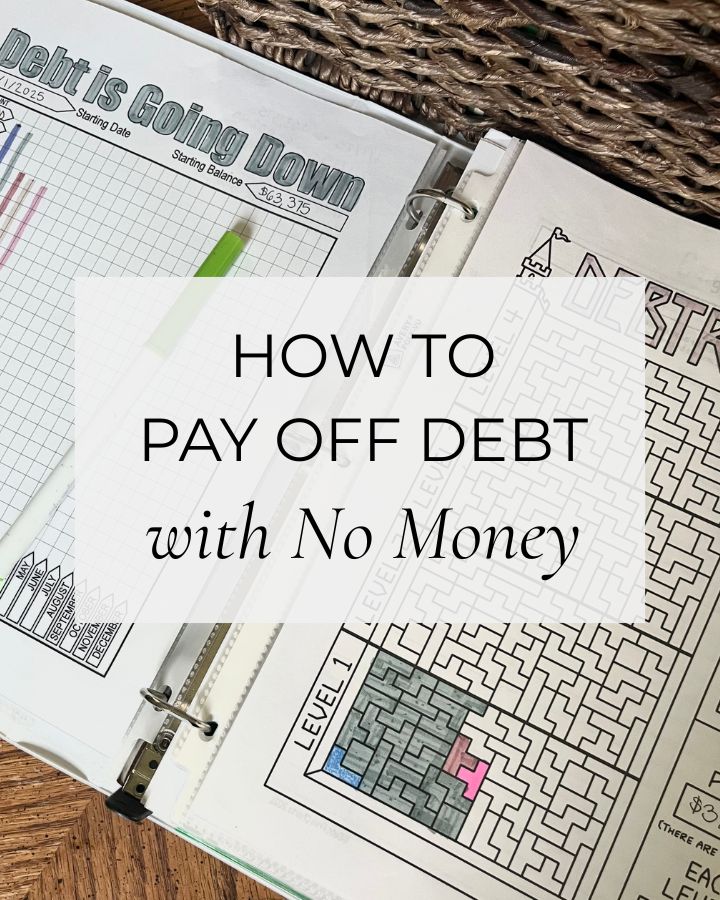
A visual debt payoff tracker can help you see how far you have come and how much longer you have to go.
I personally use Debt Free Charts because they are amazing and they are free! Every month, I sit down and update my charts and color in the spots. Looking over the debt free charts always motivates and encourages me.
9. Focus on One Financial Goal at a Time
Stop all savings and investing while you are paying off debt. Trying to do multiple things at once will slow down your progress. Tackle one goal at a time! You will reach each goal faster, and that will motivate you to tackle the next goal…and the next goal!
10. Use a Bill Organizer
Make a list of all your subscriptions, checks you wrote, bills that you got in the mail, etc. so you don’t miss any. Missing bills can throw off your debt payoff progress, and it can be easy to miss some if you are not organized. My personal finance tracker comes with a great bill organizer tab!
11. Lower Your Bills
Shop around and switch to different companies for your insurances, cell phone service provider, internet provider, and whatever else you can lower! You could even change plans, such as to a lower data plan for your phone or less coverage on your vehicle.
I try to shop around and lower our bills every couple years. You can save hundreds of dollars a month by lowering your bills to the most budget-friendly plans. If you are struggling to find extra money in your budget, this is an incredibly helpful way to find extra money to throw towards your debt!
12. Practice Contentment
True progress towards financial freedom will come once you learn the art of contentment. Desiring different circumstances, a different life, different clothing, or a different car will keep you stuck in a cycle of always wanting more. It’s more difficult to control your spending habits if you aren’t satisfied with your life and what you have.
I love this Laura Ingalls Wilder quote: “As the years pass, I am coming more and more to understand that it is the common, everyday blessings of our common everyday lives for which we should be particularly grateful. They are the things that fill our lives with comfort and our hearts with gladness — just the pure air to breathe and the strength to breath it; just warmth and shelter and home folks; just plain food that gives us strength; the bright sunshine on a cold day; and a cool breeze when the day is warm.”
13. Do a No-Spend Month
Have you ever tried a no-spend month? Completing a no-spend challenge can help you cut down on any extra spending, so you can put more money towards your financial goals! You can decide the level of sacrifice, what rules you will have, and how long you will do the challenge. Get free no-spend trackers in this post!
14. Avoid Shopping
Avoid unnecessary shopping. I try to not walk around any stores; I only go into a store if I have a specific need. I even avoid resale shops and garage sales. Don’t go unless you absolutely need something!
15. Never Pay Full Price
When you do need to buy something, don’t accept the full price. Check Facebook Marketplace, garage sales, thrift stores, or ask around before buying something new. It can be a humbling experience, but will reap rewarding financial progress! And keep your mind focused on what you need, so you don’t buy things you don’t need!
Paying off Debt Final Thoughts

If you’re trying to pay off debt on a low income, the tips above will help you make progress. The main idea is to increase the margin in your budget and live BELOW your means in order to have extra money to pay down your debts. Budget hard, lower your expenses, and keep being intentional with your spending. Every little bit helps when paying off debt!
If you have any more tips on paying off debt, share in the comments below!
Pin it!

![Dave Ramsey Recommended Budget Percentages [Calculator]](https://littlehousebudget.com/wp-content/uploads/2024/04/Dave-Ramsey-Budget-Percentages-Featured-Image-720-×-900-px-2.jpg)


2 Comments